The Last Ten Percent: What Happened When I Handed My Unfinished Work to Other People
I have a shelf in the workshop that I have started calling the Nearly Shelf. It is where projects go when they are 80 or 90 per cent done and I have lost interest, run out of the right screws, or decided the final ten per cent is going to be fiddly. This autumn I decided to empty it by giving three of those nearly-things to other people. Not as a lesson for them. More as an experiment for me.
The rule was simple: finish it so it works, not so it looks like I made it. No matching grain. No invisible joins. No sanding until my arm gives out. Just get it to the point where it can leave the shed and do its job.
I expected to feel relieved. I did not expect to learn quite so much about the difference between care and control.
Three projects, three pairs of hands
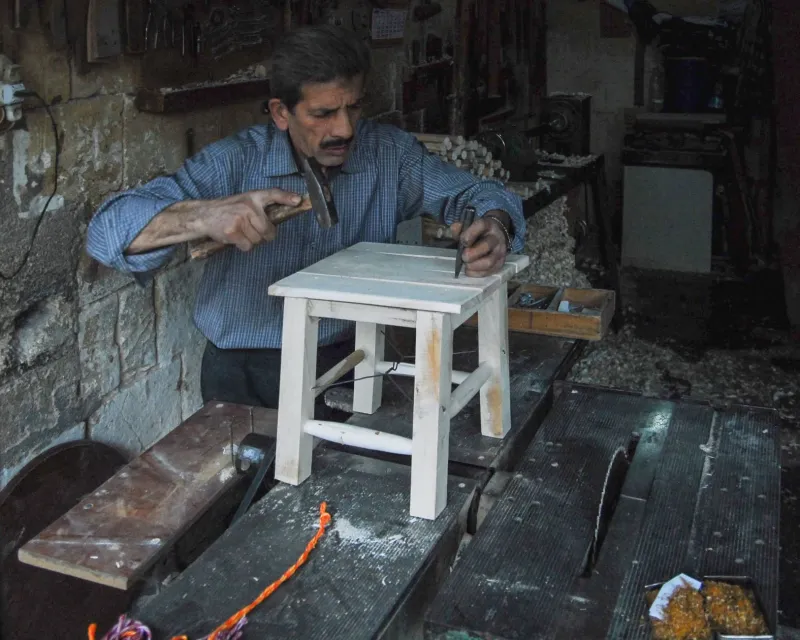
The first was a small oak stool I had built for the kitchen but never sanded properly. The legs were slightly out, the seat was a bit thick, and I had convinced myself it needed another two hours of fettling. I gave it to Cath, my neighbour, who has a better eye for practical things than she gives herself credit for. She sanded the edges until they felt nice, whacked a bit of oil on it, and put it by the back door. It still has one leg that sits a millimetre off the floor. It does not wobble when you sit on it. That, she said, is the whole point.
I had been judging the stool by symmetry. Cath judged it by whether it held a person. Both are standards. Only one of them mattered for a stool by a back door.
The second project was a half-made shelf for the local pub. I had cut the boards and drilled the holes, then stalled because I could not decide on the bracket style. Dev, a friend who is far more decisive than me, took it on. He used black metal brackets I would never have chosen, painted the boards a dark green, and fitted it in an afternoon. It looks like it belongs in a pub. My version would have looked like it belonged in a workshop run by a man who owns too many clamps.
The third was a lamp I had rewired but not finished. The cable was too long, the switch was in the wrong place, and I kept meaning to sort it. Tom, who volunteers at the repair café and has never met a screw he did not trust, took it home. He shortened the cable, moved the switch to the base, and added a little brass finial that I would have spent a week choosing. The lamp works. The woman who owns it likes it. Tom told me he had done it in twenty minutes while waiting for his tea to brew.
The hovering tax
What I had not accounted for was how much time I would spend not correcting people. I hovered. I sent messages. I asked Cath whether she had thought about sanding the other edge. I asked Dev whether the brackets were level. I asked Tom whether the switch was safe. All three of them said yes, or words to that effect, and carried on.
That hovering is the real cost of holding on to the last ten per cent. It is not the sanding or the choosing. It is the mental space of watching someone else do a job you have decided is yours. I spent more energy supervising than I would have spent finishing.
There is a particular kind of discomfort in watching someone use a tool differently from you. Cath sanded with the grain in a way I would not have. Dev drilled without a pilot hole and got away with it. Tom used a connector block I would have replaced. None of it mattered. The stool holds. The shelf is up. The lamp lights.
What other people notice
Here is the thing I keep coming back to: other people notice the things that matter to the object, not the things that matter to the maker. Cath noticed the stool needed to be stable. Dev noticed the shelf needed to look like it belonged in the room. Tom noticed the lamp needed to be easy to switch on in the dark. I had been noticing the things I would have done differently.
That is not a criticism of my standards. It is a reminder that my standards are not universal. They are habits. Some of them are useful. Some of them are just the way I learned to do things. When you hand a project over, you find out which is which.
The overconfident volunteer was the best test. Tom does not agonise. He does not wait for the perfect bracket. He looks at the job, finds a solution that is safe and works, and moves on. I found that slightly alarming. I also found that the lamp was finished before I had even decided what to do with the cable.
Where the standards actually live
I used to think my standards lived in the finish. The sanded edge. The tight joint. The hidden screw. Now I think they live in the decision about what the object is for. A stool for the kitchen needs to be safe and stable. A shelf for the pub needs to hold glasses and not look embarrassed. A lamp needs to switch on. Everything else is preference.
That is not an argument for sloppy work. It is an argument for knowing which parts of the work are load-bearing. If I hand over a project and the other person gets the load-bearing parts right, the rest is style. And style can be borrowed. It can even be improved by someone who has not spent three weeks staring at the same piece of wood.
Good enough is not a lower standard. It is a clearer one. It asks: what does this need to do, and who is it for? The answer is usually simpler than the voice in my head that says the seat needs another hour of sanding.
The shorter shelf
The Nearly Shelf is shorter now. The stool is by the back door. The shelf is in the pub, holding a row of glasses and a small brass clock. The lamp is in someone else's front room, doing its job.
I have started handing things over at 80 per cent now, on purpose. Not because I cannot finish them, but because I have learned that the last ten per cent is often where my standards get in the way of someone else's good work. And because I would rather have three finished things and a brew than three nearly-things and a clean conscience.
If you have a Nearly Shelf, I recommend it. Find someone who does not care about the same details as you. Give them the rule. Then make yourself a cup of tea and try not to hover. It is harder than it sounds. It is also, I think, the most useful thing I have done in the workshop all year.