Five Descriptions, Zero Compliments: What Happened When I Asked for the Plain Truth

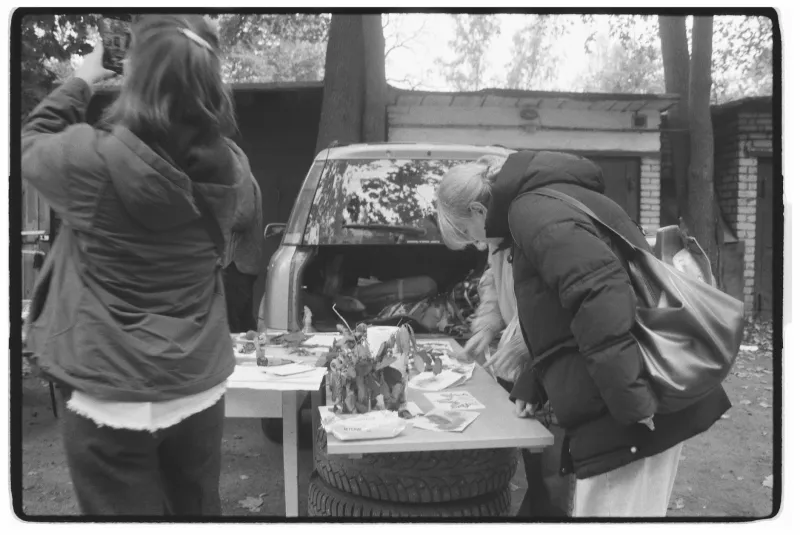
Last month I did something slightly awkward at my local Saturday makers' market. I put one of my pieces on the table, moved the price card out of sight, and asked five people to describe it to me. Not to review it. Not to tell me whether they liked it. Just to say what they thought it was, who it seemed to be for, and what felt unclear.
The piece was a folding book stand I had been calling The Reading Slope. It is made from offcuts of oak, it holds a paperback open at a decent angle, and I was quite pleased with it. That last bit was the problem. I had been explaining it so often that I had stopped noticing how much of the meaning lived in my mouth rather than on the table.
The Rule: Describe, Don't Appraise
I asked five people over the course of a morning: Dev from next door, Priya who runs the candle stall, Martin who used to be a joiner, Ellie who buys more notebooks than anyone I know, and Sue, who had stopped to look at a bowl of my offcuts and got talked into the experiment.
The rule was simple. No compliments. No 'that's nice'. No 'you're very clever'. They had to tell me what they saw, who they thought it was for and what they could not work out. I wrote everything down in a cheap notebook, mostly so I would not start defending myself before they had finished.
It is harder than it sounds. People reach for praise the way you reach for a door handle. Dev got about four words in before saying 'it's really nicely finished', and I had to tap the card I had put on the table: describe it, don't rate it. He laughed, looked again, and said, 'Right. It's a wooden stand for a book. Maybe a tablet. I can't tell if it's meant to sit on a desk or in a kitchen.'
That was more useful than a compliment.
What They Thought It Was
Two of the five thought it was a tablet stand. One thought it was a recipe-book holder. Martin, to be fair, got it straight away, but he also thought the hinge looked like it might pinch. Ellie thought it was a display stand for a shop, not something for a normal person's kitchen table. Sue asked whether it came in a bigger size for a hardback.
Only one person used the word book before I did. That was the first proper jolt. I had spent weeks thinking of it as a book stand because that is what I had made. Everyone else was meeting the object cold. To them, it was a wooden thing with a slope and a hinge, and the rest was guesswork.
The title was not helping. The Reading Slope sounds like a sled, a garden feature or a very polite name for a hill. It told people nothing. I had chosen it because I liked how it sounded, which is a fine reason for a poem and a terrible reason for a label on a market stall.
Who They Thought It Was For
This was the part I had not expected. I assumed the answer was obvious: readers. People with books. People who like reading at the table without holding the pages open with a teaspoon.
What came back was broader and more specific at the same time. Priya thought it was for someone who follows recipes and needs both hands free. Dev thought it was for a student. Ellie thought it was for a shop display because it looked a bit too smart for everyday use. Sue thought it was for older hands that struggle to hold a book open.
None of those are wrong. That is what made it interesting. The object was doing several jobs in people's heads, and I had been advertising only one of them. Worse, I had been advertising it in a voice that sounded like me talking to myself. If someone has to ask what a thing is for, the thing is not the problem. The sign is.
The Bits That Felt Unclear
I asked them to be blunt about what felt fuzzy, and this is where the morning earned its keep.
- The hinge looked fragile, even though it is not.
- The price was hidden behind the stand, so nobody knew if they were allowed to ask.
- The word 'slope' made one person think it was a gardening item.
- There was no clue whether it folded flat for a drawer.
- It looked more expensive than it is, which sounds like a lovely problem until you watch someone put it down without asking.
That last point stung in a useful way. I had been treating the stall as a display cabinet. A few nice objects, a few nice words, hope for the best. But a market stall is not a gallery. It is a conversation with people who are half-looking and fully distracted. They are not studying your work. They are trying to work out, in about four seconds, whether to stop.
What I Changed Before the Next Market
I did not redesign the stand. I redesigned the explanation.
The label now says, in plain words: 'Folding oak book stand. Holds paperbacks and hardbacks. Folds flat. Made from offcuts.' That is not poetry, but it is honest, and it answers the three questions people actually had: what is it, what does it do, and why does it look like that?
I moved the price to the front. I put a paperback on the stand with a little card that said 'yes, it holds a book'. I added a second stand folded flat so people could see the hinge without having to ask. I stopped calling it The Reading Slope on the sign and put that name on the back of the card instead, where it can be a bit of personality rather than a puzzle.
The result was not a queue around the hall. It was better than that. People asked fewer confused questions and more useful ones. One woman picked it up and said, 'Oh, it folds. I've got a drawer that would take that.' That is the sentence you want. Not 'lovely', not 'you must be so talented'. Just a person placing your work in their actual life.
The Uncomfortable Part
There is a version of this exercise where you ask for honest feedback and then quietly decide everyone missed the point. I have done that before. It is very cosy. You nod, you say 'interesting', and you change nothing.
This time I tried to treat the descriptions as data rather than verdicts. If two people thought it was a tablet stand, that did not mean I had failed. It meant the object needed a clearer introduction. If nobody used the word book until I did, the sign was doing too little and my mouth was doing too much.
It also made me realise how often I use charm as a substitute for clarity. At a stall, you can talk someone into understanding a thing. Online, or on a shelf in a shop, you cannot. The work has to carry a bit of its own explanation. That is not selling out. It is just being polite to the person looking at it.
Why Plain Words Beat a Compliment
Praise is a receipt for effort. It tells you someone is being kind, or that they like you, or that they feel they should say something. It is not nothing. But it does not tell you what your work looks like to a stranger in November 2026, standing in a church hall with a coat on and a bus to catch.
Description does. It tells you what your object is broadcasting before you arrive to explain it. It tells you which words are doing their job and which ones are just decoration. It tells you whether your title is a door or a hedge.
I would do it again. Five people, one notebook, no compliments. It is cheaper than a rebrand and considerably more useful than a nice comment from someone who loves you. If you make things and sell them in person, try it. Put the price card away, ask a neighbour what they think they are looking at, and write down the answer without arguing.
You may not like everything you hear. But you will probably learn what your work says when you are not there to say it for it.