The Toaster That Refused to Die: Six Saturdays Behind a Repair Café Table
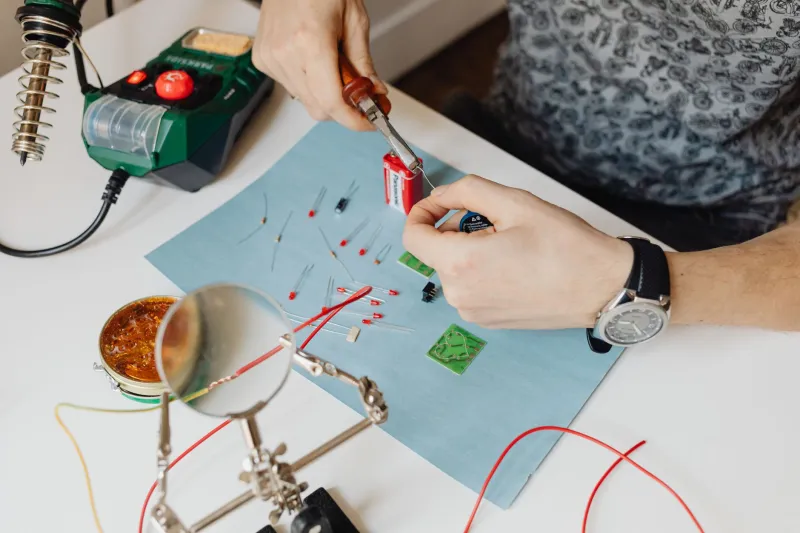
There's a smell to a village hall on a Saturday morning that I could now identify blindfolded: floor polish, urn water that's been simmering since eight, and the faint burnt-plastic tang of somebody else's broken kettle.
I've spent six Saturdays in that smell this year. Not as a customer — as a volunteer, sat behind a trestle table with a cloth over it, a jar of fuses I couldn't identify in week one, and a screwdriver set that has quietly become the most-used thing I own.
I went in thinking I'd be learning about wiring. I came out having learned something far more useful about why I never finish anything.
The First Saturday: A Queue of Small Failures
You expect a repair café to be about appliances. It's actually about the moment someone hands you a thing and says, 'I know it's daft, but I'd rather not bin it.'
On my first morning the queue included a Dualit toaster heavy enough to anchor a small boat, an iron with a scorched flex, a bedside lamp with a moulded plug that had gone brittle, a food mixer that hummed and then didn't, and a set of Christmas tree lights someone had clearly been meaning to deal with since about 2019.
By eleven o'clock the table had four volunteers on it, two of whom knew what they were doing, and a sign-in sheet that was already on its second page. Somebody had brought a tin of biscuits. Somebody else had brought a flask. A woman called Margaret was sitting patiently with a lamp, not because she was in a hurry, but because she'd decided Saturday morning was lamp morning.
The insurance disclaimer gets read out at the start of every session, and so does the bit about PAT testing, which is the closest thing the modern world has to a religious ritual. Then the lids come off and the real business begins.
It's Nearly Always the Fuse, and Other Unfashionable Truths
Here's what six Saturdays taught me about broken things: the dramatic diagnosis is almost never right.
I had arrived expecting to be dazzled. In practice, a decent share of the items that came through the door were fixed by a plug, a fuse, a loose terminal or a switch that had simply given up. The Dualit was rewired in about eleven minutes by a retired electrician who did it while explaining something unrelated about his allotment.
The same pattern holds for creative work, and I don't love admitting it. When a project stalls, I assume it needs rescuing — a new direction, a fresh start, a big idea. Nine times out of ten it needs the boring equivalent of a fuse: the file that was never named properly, the email that was never sent, the last twenty minutes of tidying that turn a pile into a thing.
Boring fixes are unglamorous, which is exactly why they sit undone for months.
The Lamp That Was Actually a Grief
Margaret's lamp took four of us about forty minutes and should have taken ten. The switch was gone, the flex was perished, and the shade had a scorch mark on it that she asked us not to cover up.
While we worked she told us it had been her husband's reading lamp, that he'd died two years ago, and that she'd been meaning to bring it in since the spring but kept putting it off because bringing it in felt like a statement.
We got it going. She asked if she could switch it on herself. Then she sat with it glowing on the trestle table for a good while before wrapping it in a tea towel and taking it home.
That's the bit I hadn't accounted for. Nobody in that hall was there purely to save money or landfill space, although both are decent reasons. They were there because a broken object is usually attached to a small unfinished feeling, and finishing it in front of another person makes it possible.
What This Has to Do With Finishing Anything
I've written before about the page before the saw, and about the shelf of dead projects in my workshop. This is the missing piece I hadn't spotted: the reason those projects died wasn't lack of skill or even lack of time. It was that nobody was waiting for them.
At the repair café, someone always is. There's a person sitting opposite you, and their toaster is on your table, and you have until twelve thirty. That's not pressure in a nasty sense — it's structure. It's a diary entry with a face attached.
So I've started borrowing the format. Once a fortnight I take a half-finished thing to a mate's kitchen table and we both work on our own stalled projects for two hours, side by side, saying almost nothing. It is astonishingly effective. Not because we help each other, though occasionally we do. Because the last twenty per cent of anything is boring, and boring things are far easier in company.
Three Things I'd Tell Anyone Starting Out
First, say the finish out loud to a person. Not a plan, not a post. A sentence to a human being who will remember it. 'I'll have this done by the end of the month' said to someone in a hall is worth ten to-do lists.
Second, learn to write things off honestly. Not everything at a repair café can be saved, and the volunteers are refreshingly unsentimental about it. One bloke brought in a strimmer that had been outside for three winters and was told, kindly but firmly, to let it go. I've started doing the same with projects. There's a difference between a stalled thing and a dead thing, and pretending otherwise is how a workshop fills with ghosts.
Third, bring the right screwdriver. Half the frustration in any repair is a tool that almost fits. Mine is not a metaphor — it's a set of Torx bits I bought in week two — but it is also, annoyingly, a metaphor.
The Bit Nobody Puts on the Poster
The posters always say something about waste and recycling, which is true and important. The thing they don't say is that a repair café is one of the last genuinely mixed rooms left in this country. One morning I watched a retired engineer, a teenager with a drifting controller, a bloke in a hi-vis jacket on his break and a woman with a food mixer that turned out to be fine argue amiably about which fuse goes where for an hour and a half.
If you've got a village hall, a church room or a community centre near you, there's a good chance one runs monthly or fortnightly near you — the network has grown steadily and most sessions are free, with a donation tin by the tea. Take something broken. Take something you've been meaning to fix since last winter. Sit down. Stay longer than you need to.
You'll get your toaster back. You'll also get a slightly better idea of why you keep abandoning things at eighty per cent.
And if the volunteers can't fix it, they'll tell you straight, which is more than most of my own projects have ever done for me.