Envelope First, Link Later: A Month of Making My Work Travel by Post
I have spent most of my creative life pressing publish. A link goes out, a thumbnail appears, and the work is instantly somewhere and nowhere. So for four weeks this November, I ran a small experiment: every finished thing I wanted to share had to leave the house as a physical object first. A zine, a print, a handwritten note, a photocopied page. It had to be wrapped, addressed, stamped and handed over a Post Office counter. No link until it had survived the journey.
The Rule and the First Envelope
The rule was simple and faintly ridiculous. If I wanted someone to see it, it had to go through the post. Not courier, not hand-delivered on the way to the shop, not a PDF attachment. Actual Royal Mail. I gave myself a budget of £20 for the month and a shelf in the workshop for outgoing parcels.
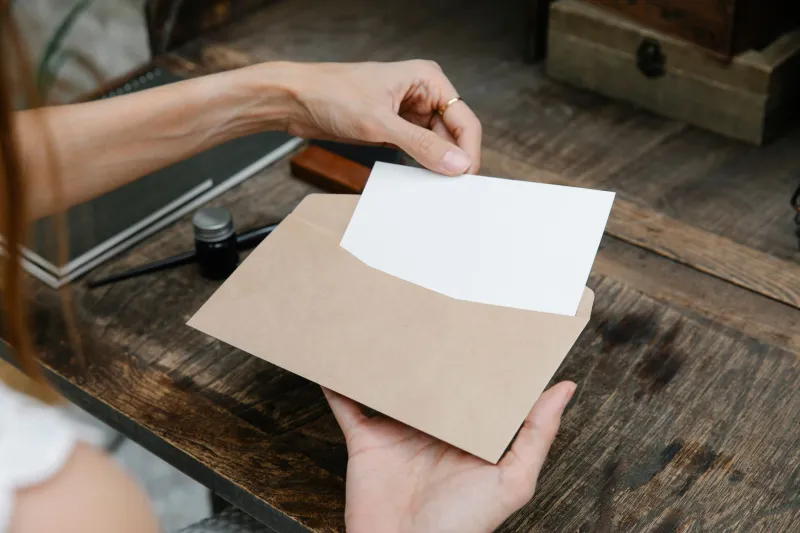
The first envelope took forty minutes. I faffed with brown paper, misjudged the fold, wrote the address twice because the first attempt looked like a spider had fallen in ink. I walked to the sub-post office on the high street, joined a queue of six, and felt oddly exposed. The woman behind the glass weighed it, asked if I wanted second class or first, and I said second because it felt more in keeping with the whole slow idea.
Packaging Is Editing
What I hadn't expected was how much the wrapping would change the work. When you have to fold a piece of paper into an envelope, you notice its edges. You notice whether the title reads from the outside. You notice the weight. A print that felt finished on screen suddenly needed a backing board. A zine that seemed fine as a PDF needed a cover that could survive a sorting office.
I started trimming. Not because the work was bad, but because the physical form asked different questions. Does this need a note? Does the note need to be a paragraph or just a line? Is the address label part of the thing now? Packaging is editing with Sellotape.
The Postage Maths
I am not a natural mathematician, but I became briefly obsessed with postage. Large letter versus small parcel. The difference between 100g and 250g. Whether a padded envelope tips you into a different price band. I bought a cheap kitchen scale and kept a list of weights on the back of an envelope.
The maths forced decisions. If I wanted to send three zines, it was cheaper to send them together. If I wanted to include a handwritten note, it had to be light. The budget wasn't tight, but it was real. Twenty quid disappears quickly when a large letter is £1.55 and a small parcel is £3.29. I found myself asking whether each piece was worth the postage. That is a useful question. It is also a slightly brutal one.
What the Counter Taught Me
The Post Office queue is a strange kind of focus group. Nobody there cares about your creative practice, but they do care about whether the envelope is sealed properly. I had a conversation with a man in a fleece about the correct way to tape a corner. I was told, kindly, that my handwriting was 'optimistic'. I learned that 'proof of postage' is free and that the phrase 'it's not fragile, it's just paper' does not inspire confidence.
The counter staff became a small, accidental audience. They didn't know what was inside, but they handled the outside. That made me care about the outside more. A few asked what I was sending. I said 'a zine' and they nodded as if that were a normal thing, which in a Post Office it is.
What Came Back
The feedback was different. When I send a link, I get a like, maybe a reply, usually silence. When I post something, I get a message a few days later: 'It arrived.' Sometimes a photo of it on a kitchen table. One person said they'd read it on the train because they'd put it in their bag. Another said the envelope had got a bit damp and they'd dried it on a radiator. That is not a metric I can put in a dashboard. It is better than a dashboard.
Not everything landed. One piece went missing for a week and turned up with a bent corner. Another, I suspect, is still in a pile by someone's front door. But the ones that arrived felt more deliberate. The work had travelled. It had been handled. It had cost me something, and it had cost the recipient a small moment of opening.
Would I Do It Again?
I won't do it for everything. I like the speed of a link, and I'm not going to pretend that a month of queueing has cured me of wanting to share things quickly. But I will keep a shelf for physical post. I will keep the kitchen scale. I will keep asking whether a piece is worth an envelope.
The experiment didn't make my work better in any obvious way. It made the release slower, and slower turned out to be more honest. The queue doesn't flatter you. It just weighs the thing and asks for the money. That's a decent test for anything you're about to send into the world.