The Gavel Did the Shopping: Six Weeks With One Auction Box

Photo: Peter Facey, CC BY-SA 2.0, via Wikimedia Commons
I bought a cardboard box at the village auction for £17. Then I spent six weeks making things only from what was inside it. No trips to the hardware shop. No quiet online order for the one hinge I actually needed. No “I’ll just nip out for a better piece of oak.”
The box was lot 61. It came from the back of a hall that smelled of tea urn and damp coats, and it was sold by a man with a gavel and a mug that had seen better days. I had gone along to watch, which is what people say before they bid on something they do not need. When the lot came up, I put my hand in the air because the box looked heavy and because nobody else seemed to want it.
By the time I got it home in late September, the evenings were already pulling in. I put the box on the bench, made a cup of tea, and opened it like a slightly suspicious present.
The Rules I Made Up on the Drive Home
The rules were simple enough that I could not wriggle out of them later. Tools were allowed. Consumables were allowed — glue, sandpaper, finish, the odd screw from the jar of rescued screws I keep by the saw. New material was not. If I needed a piece of wood, it had to come out of the box or out of the offcuts bin, and the offcuts bin was only allowed if the piece was genuinely too small to be useful for anything else.
I also decided I could not buy a “better” version of anything in the box. That meant no replacing the split tray base with a nice bit of ply. No buying a new clock movement because the old one was beyond me. No popping to the charity shop for a piece of fabric that matched.
It sounds restrictive. It was. That was the point.
What £17 Actually Buys
The box contained: a wooden tray with a split base, six piano keys, a bag of brass hinges, a roll of green felt, a broken mantel clock, a length of dowel, a tin of beeswax, some upholstery fabric, a small box of mismatched screws, and a wooden ruler with someone else’s initials burned into the back.
There was also a smell. Not a bad smell — more like old shed, beeswax and faint tobacco. The kind of smell that tells you these things had been kept for a reason, even if the reason had long since been forgotten.
I laid everything out on the bench and tried to look at it as a set of possibilities rather than a pile of other people’s junk. That took longer than I expected. When you choose your own materials, you can hide behind them. You can pick a nice bit of ash and let the grain do the talking. When the box chooses for you, you have to make the argument.
The Box Has Opinions
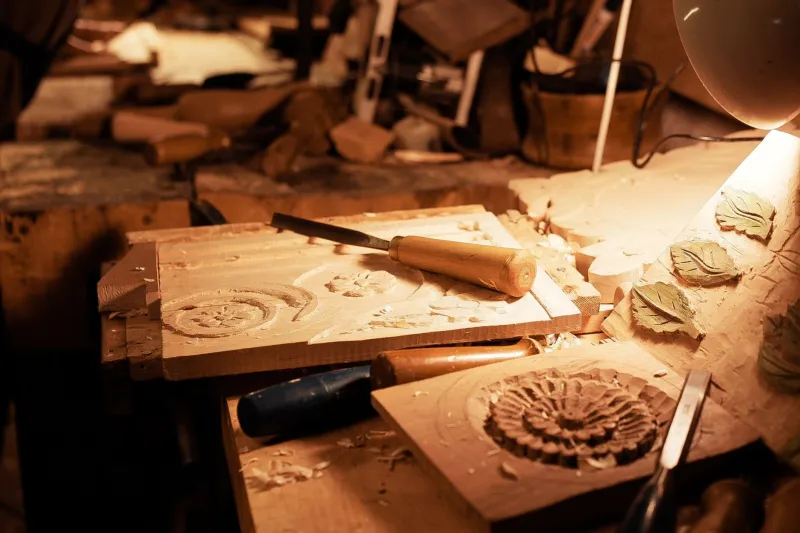
The first thing I made was a small wall-hung cabinet from the tray. I cut the split base down, added a shelf from the dowel, lined the compartments with green felt, and used the piano keys as pulls. The hinges were brass and slightly bent, so the door sits a little proud on one side. It is not a beautiful object. It is, however, an honest one.
The second project was a repair. The broken mantel clock had a case that was still sound, so I cleaned it up, fixed the loose back panel with a piece of the upholstery fabric as a hinge, and left the movement alone. It does not tick. It now holds the screws I did not use. I am aware that this is not what a clock is for.
The third thing was a small bench hook from the ruler and a piece of the tray base. It is ugly and it works. I have used it every day since.
What I noticed, about halfway through, was that I had stopped thinking about what I wanted to make and started thinking about what the box would allow. That is a different kind of thinking. It is closer to repair than design. You are not imposing a vision; you are answering a question that has already been asked by the materials.
Taste, Waste and the Half-Finished
A box of other people’s leftovers is a record of small decisions. Someone kept those hinges because they were still good. Someone kept the piano keys because they might come in useful. Someone kept the beeswax because it was half-full and you do not throw away half-full beeswax.
That is not a mood board. It is a biography of mending. And it tells you something about taste — not the taste of a stylist, but the taste of a person who saves things. There is a kind of honesty in that which you do not get from a curated palette.
It also made me think about waste. Nothing in that box was rubbish. It was unclaimed. The difference matters. Rubbish is something nobody wants. Unclaimed is something nobody has got round to wanting yet. Six weeks with that box made me realise how often I buy new material not because I need it, but because I have not looked properly at what is already on the shelf.
Why a Village Auction Is a Better Brief Than a Mood Board
A mood board flatters you. It tells you what you like and then helps you buy it. An auction lot does not care what you like. Lot 61 did not know my style, my workshop, or my plans for the weekend. It just sat there in a cardboard box and waited for someone to take it home.
That is what makes it an honest brief. It has no marketing. It has no colour of the year. It has a split tray base and six piano keys and a clock that will never tick again. Your job is to make something from that, and to do it without pretending you are someone else.
By the first week of November, the box was empty except for a handful of screws and a smell of beeswax. I had made three things, repaired one, and learned more about my own habits than I have from most books on creativity. I would not want to work like this all the time. But once a year, I think it is worth it.
The gavel did the shopping. I just had to keep up.