Between the Shelves: Five Creative Habits I've Built Inside My Local Library
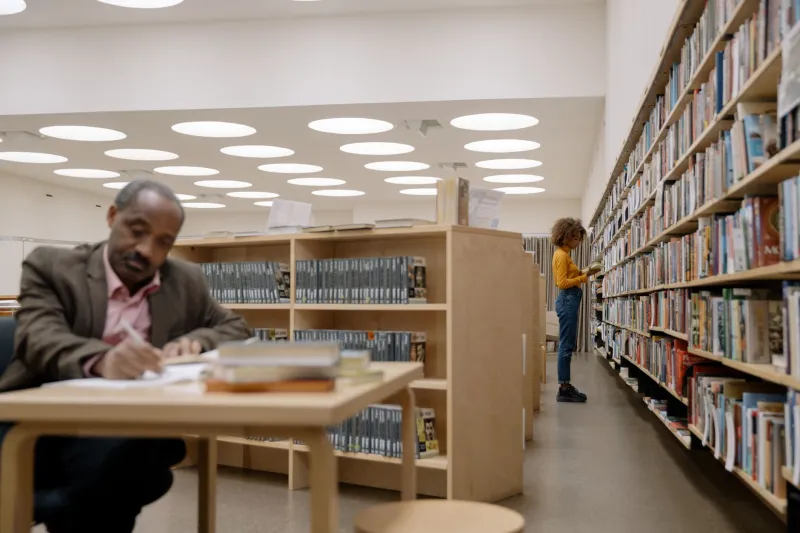
I don't have a studio. I have a spare bedroom with decent light, a shed with a damp problem, and a library card that gets more use than both.
Two years ago I started going to my local branch on Wednesday mornings for one reason: I wanted a table that wasn't covered in my own half-finished work. It's since become the second half of my working week, and not for the reasons I assumed. I don't go there to get through a to-do list. I go because the building makes one kind of thinking easier and another kind impossible.
If you're in the UK and you haven't been inside your local branch since you were seventeen, you'll be surprised. They're not quiet mausoleums. Most have wi-fi, a printer, a warm room in January and a librarian who knows more about your town than the council website does. Here are the five habits I've built there, and what each one actually does.
One: the reference table, booked like a meeting
Every Wednesday, 9.30 to 10.30, I sit at the big table beside the local studies shelf. The one with the heavy books you can't take home — the old Ordnance Survey maps, the bound copies of the local paper, the trade directories for businesses that stopped existing in 1974.
The table has no plug sockets. That's not a complaint, it's the entire feature. No sockets means no laptop, which means I'm either reading or writing by hand, and there is no third option where I "quickly check something". I take a notebook, a pencil and one question I wrote down on the walk in.
What it changes: research becomes something I do rather than something I keep meaning to do. An hour of handwriting in a room where nobody can message me produces about four pages of notes, and roughly one of those pages is useful. That's a far better ratio than six browser tabs and a lost evening.
Two: the magazine rack is the cheapest trend report you'll ever read
I don't subscribe to anything. I read the rack.
There's a row of armchairs by the window in my branch and about forty magazines, half of them a month out of date. I give it twenty minutes, I take an index card, and I write down only what makes me stop — a colour, a layout, a phrase someone used, a shape I want to try out on a bit of scrap. No photographing pages, no tearing anything out. If it matters that much, I note the issue and the page and come back to it.
What it changes: it breaks the algorithm. Everything I'd normally read has been chosen for me by something that already knows what I like. The rack doesn't know me at all, and I've noticed the things I linger on in a room full of magazines I'd never have picked up are often closer to what I actually want to make.
Three: one book, one question, one week
The rule is simple and I've broken it maybe twice: I borrow one book at a time, it has to answer one named question, and it goes back within seven days whether or not I finished it.
The question gets written inside the front cover in pencil, because the book belongs to everyone and pencil rubs out. Last month it was "how do you bind a book with a limp cover?" The book was 300 pages long. I read forty of them, made the thing, returned it on the Monday.
What it changes: it kills the to-be-read pile. A borrowed book becomes a tool instead of an ornament, and a deadline the library set for me is weirdly more persuasive than one I set for myself. The reservation system does most of the work — request it online, collect it from the desk when the slip arrives, and the clock is already running before your enthusiasm has a chance to fade.
Four: the request shelf is a live focus group
This one is small and a bit nosy. When you collect a reservation, the books sit on a shelf behind the desk with paper slips in them, and if you stand there for a minute you can see what the whole town is asking for. Some of it is predictable. Some of it isn't.
I don't read the names. I read the titles. A branch with twelve holds on a book about dry stone walling is telling you something about the place you live in — and if you make things for people in that place, that's information no dashboard will ever give you.
What it changes: it keeps me honest about audience. Not "what is trending online", but "what are the actual humans within four miles of my kitchen table interested in this month".
Five: the walk home, no headphones
Ten minutes between the automatic doors and my own front door. No podcast, no music, no phone in my hand. One note written before I go inside.
It sounds soft, but it's the habit that does the most work. An hour of reading followed by a quiet walk is where the connections happen — the thing I read in the reference room bumps into the thing I saw on the rack, and by the time I reach the gate I've usually got a sentence worth keeping.
What it changes: it gives the session an ending. Without it, everything I've just done gets buried under emails the second I'm back at a screen.
A word on manners
A library is not a free office and it's not your personal studio, and if we treat it like one we'll lose the goodwill that keeps the doors open. Take calls outside. Don't camp at a table with a full day's kit and a flask. Buy a coffee on the way in from somewhere local. Pay for your photocopying without a fuss. Join the Friends group, or at the very least fill in the consultation when the council threatens the budget, because that threat is annual now and it isn't hypothetical.
And if you've got a spare hour, ask the librarian what they actually need. Ours wanted someone to run a basic repair session. That's now a thing I do four times a year, and it's given me more from that building than any desk I've ever paid for.
Wednesdays, 9.30. Bring a pencil.